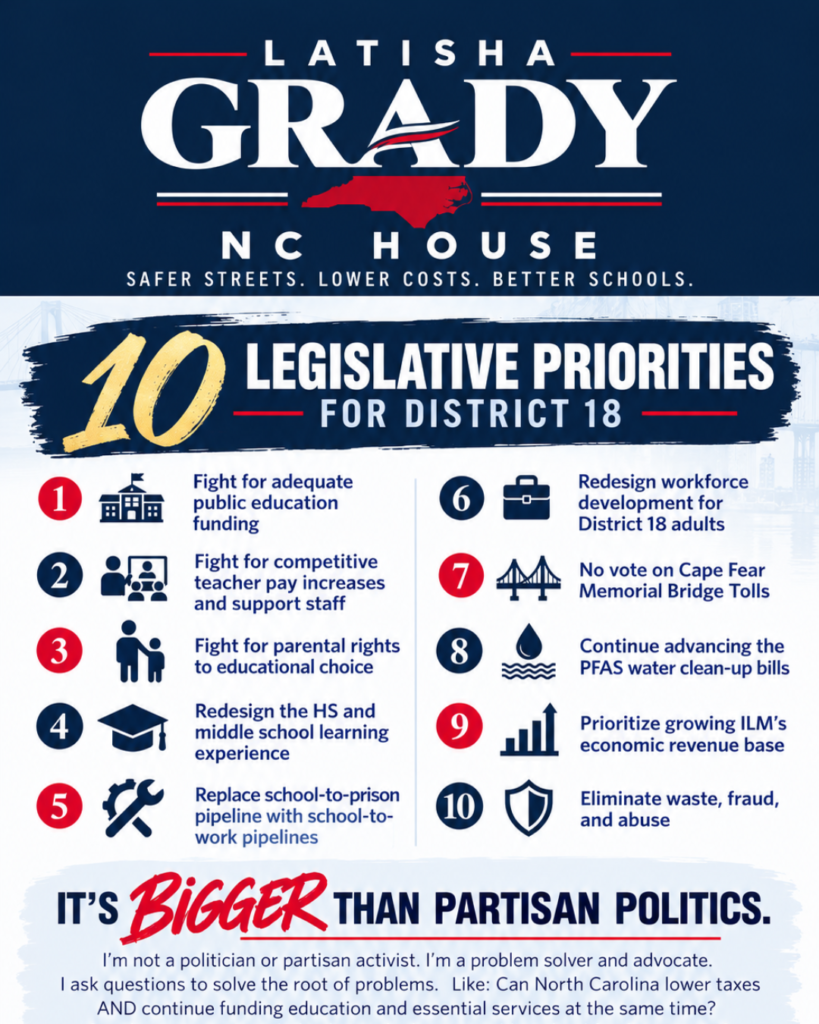

Question: As part of your platform, you’ve talked about immigration reform and suggested tougher penalties for employers hiring illegal immigrants. What would enforcement of that look like to you? And what do you think the impact would be on our state’s agricultural and construction industries?
Answer: Enforcement for employers look like increasing the fines–currently in the law–making is more costly for first offenses and repeat violations. Enforcement for those here illegally would be deportation. As my website states, those who take accountability for their actions and self-deport may be eligible to apply for legal re-entry.
Question: So you think there is demand for some of those lower-paying agricultural jobs?
Answer: Yes. Interest in agricultural entrepreneurship and trade careers is growing, especially in the Black community. Construction, plumbing, HVAC, landscaping, and farming are not low-paying jobs. They are labor intensive jobs. American veterans, eligible teens, and formerly incarcerated individuals eligible for work release could fill these jobs. Migrant hiring has suppressed wages in these fields for decades making them “lower-paying” than they would be otherwise-which is why employers must be held accountable.
2. Portable Health Insurance
Question: One of your proposed policies is decoupling health insurance from employment and making those plans portable. How would you address federal law, including the Affordable Care Act (ACA) requirement that employers with 50 or more workers offer affordable coverage?
Answer: Decoupling doesn’t eliminate employer plans. It creates a second way to buy insurance outside of a job and without government subsidies like the (ACA). Life insurance works this way and is a better comparison than my initial auto example. You buy a policy through an employer, on your own, or both, and your personal policy follows you if you leave a job. Many gig workers are priced out of the ACA and go uninsured. It’s cheaper to pay out of pocket or join a direct primary care network for routine care. This could be one fix but it would need expert and legislative input to refine.
3. Military Service & Juvenile Justice Reform
Questions: On your campaign blog, you discussed the possibility of exploring mandatory military service in sentencing for certain kinds of repeat offenders. What would that look like ideally to you? Most branches of the military do not allow people to accept military service as an alternative to sentencing. So how would you work around that?
Answer: I don’t know what it would look like, yet. This blog post documents the conversation I had with four young marines, referenced at the forum. I clearly state this as an idea (legislative brainstorm) worth exploring as to whether or not a mandatory pathway “could” be created to give juveniles facing significant jail time an alternative with upside. I am thinking outside the box as I want to mitigate youth crime and poverty cycles in District 18. This alternative could do both. If the military won’t allow it, a military-style boot camp could serve the same corrective purpose. Another example where expert and legislative input is needed to refine.
4. Funding Education with Tax Caps
Questions: You support a number of educational investments, including funding for early literacy, tax relief for teachers, and bringing back master’s pay. How would you fund those initiatives?” With the state looking to cap the amount that local governments can raise while also lowering its own tax rates, there is going to be a financial squeeze. So how would you fit your initiatives into the overall budget?
Answer: Based on what I know about the history of Democratic majorities in NC before 2011, I reject the progressive framing of this question. It presupposes that the progressive characterization of this issue is accurate. Where were these questions and concerns when state income taxes were at 7.75%, Democrats ran a $5B deficit, and local governments had freedom to raise property taxes without caps? What majority voted to remove the mandatory 35% lottery allocation for education in 2007? These tax cap amendments are necessary to protect income tax payers and homeowners from progressive fiscal policies that repeatedly fail. Look at California, Chicago, NYC, Minneapolis, Los Angeles, Charlotte, Asheville. Certainly, we can (and should) increase education funding while at the same time ensuring municipal services remain adequately funded. But only once we ascertain what funding number is “adequate” and realistic baselines are set. I urge voters to compare past Democratic majority leadership with the GOP’s 15-year record of delivering tangible results at state, city, and county levels.
5. Transforming the Middle and High School Experience
Question: One of your policy platforms is transforming the middle and high school experience to redirect and prevent youth crime. Can you say more about that?
Answer: My platform on this issue builds on ideas inspired N.C. Senate Bill 579 and the Chamber of Commerce Career Leadership Development Academy in partnership with the NHC Board of Education. I advocate expanding these programs into middle school, introducing CTE as early as 4th grade (like Philadelphia’s Mayfair Elementary School), as well as adding student preparedness in fields like blockchain, cybersecurity, and AI. Careers in these sectors have high demand for regulatory compliance, ethics, and fraud prevention which all require human judgment making these jobs essential. I created this policy brief from my ideation session back in the spring when I first became aware that my thinking on this issue was already in alignment an existing bill.