
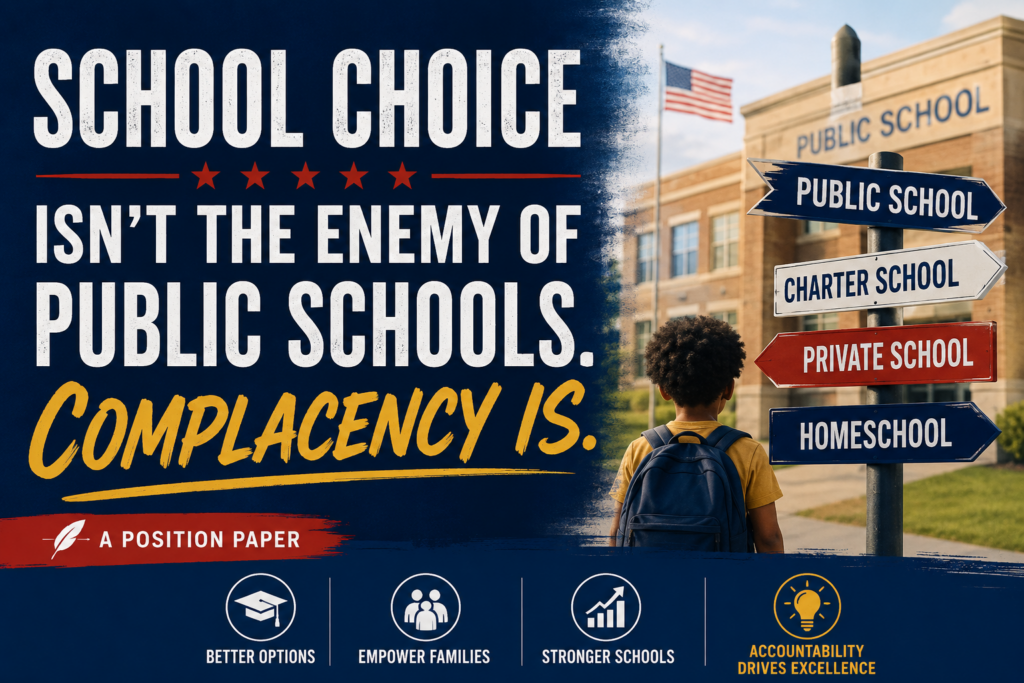
School Choice Isn’t the Enemy of Public Schools. Complacency Is.
Every year, the fight over North Carolina’s Opportunity Scholarship program follows the same script. Supporters call it freedom. Opponents call it a raid on public education. Both sides talk past the one question that actually matters: why would any parent — rich, poor, Black, white, rural, urban — want to take their child out of a specific public school in the first place?
That’s not a rhetorical question. It’s the whole debate, if we’re honest about it.
My Position
I support expanding the Opportunity Scholarship to families at every income level, with the deepest support going to those who need it most. Critics say this hands public money to wealthy families who were always going to choose private school anyway.
Some of that criticism is fair, and I’ll come back to it. But underneath a lot of the opposition, stripped of euphemism, is an ideological one: that conservative policy generally favors the wealthy at the expense of the poor, and this voucher fight is one instance of that broader accusation, not a standalone fiscal dispute.
The idea that choice is fine for the wealthy, who have always had it — through the house they can afford to buy, the tuition they can afford to pay — but suddenly becomes suspect the moment it’s extended to everyone else? I don’t accept that logic. But I also don’t think supporters of this program get to wave away the legitimate part of the critique, so let me address it, directly.
The Real Fiscal Argument and What to Do About It
When a child leaves, the school doesn’t lose a proportional slice of its budget — it loses a per-pupil allotment while keeping the same building, the same bus route, and the same number of teachers on contract.
That’s how North Carolina’s public school funding works generally: state allotments are tied to per-pupil headcount, not to a district’s fixed costs, so a handful of departures spread across grade levels can leave a school thinner without letting it shrink any of its fixed costs.
That’s a credible concern and a real mechanism problem. But to be intellectually honest in this debate, critics can’t blame the scholarship program alone for a structural funding-formula gap — and supporters can’t wave the gap away by claiming only ‘instructional’ dollars leave with the student. It is a structural feature of how the state funds all public schools, voucher program or not.
It is not something the Opportunity Scholarship statute was ever designed to fix. So critics of choice can’t blame the scholarship, entirely, for this gap and supporters can’t suggest this gap is already addressed–as instructional only funding that follows the student.
The real fix is in the general school funding formula, not the OS statute.
A solution could look like holding-harmless provisions and fixed-cost adjustments for districts with declining enrollment, along with the low-wealth and small-county supplements that already exist but were never built with OS-driven attrition in mind.
On the accountability side, nonpublic schools accepting scholarship money already face some reporting — annual progress reports to parents, standardized test reporting once they enroll more than 25 scholarship students, and a CPA financial review at 70 or more — but it’s lighter than what public school units face, and it should be brought closer to parity as the program scales.
Choice and accountability are not opposites. They should be sold as a package, not treated as trade-offs.
There’s also a more specific critique worth taking seriously: in other states, early cohorts of universal voucher programs were disproportionately families already enrolled in private school, meaning the subsidy didn’t expand access so much as pay for a choice already made. That’s a legitimate design problem, and it argues for phasing in support that prioritizes families actually switching out of a struggling public school — not for abandoning the idea of choice altogether.
The Unaddressed Elephant in the Room
None of that fiscal repair work answers the deeper question: why does any family want to leave a public school in the first place?
It is rarely a political ideology. Parents leave because a school feels unsafe. Because of teacher turnover. Because discipline was either too harsh or nonexistent. Because their kid stopped feeling either safe or challenged. Because they called the front office twice and nobody called back.
A mother making $28,000 a year and a family making $280,000 will describe the exact same reasons for leaving the exact same kind of school. Income doesn’t create the problem. It just determines who has an easier time solving it without the state’s help — which is, precisely, the inequity gap the opportunity scholarship means to close.
I am running to represent a district with people experiencing poverty and wealth, and voters must know that there is no innate virtue in being poor and poverty is not a ceiling on excellence. Henderson Collegiate in Vance County — a Title I Reward School with a 100% college acceptance rate since its first graduating class — proves it: rigorous instruction, strict discipline, and a lottery wait list because demand exceeds available seats.
On the other hand, funding matters — and any argument that pretends money is irrelevant to outcomes doesn’t survive contact with the evidence. Both things are true at once, and pretending otherwise — in either direction — is how this debate stays contentious and stuck.
But just giving schools money doesn’t fix anything if there is no consistent accountability to ensure money is spent as intended or if teachers keep leaving. Some of the gap is simple dilution — that is money is spent on legitimate items, on paper, but doesn’t reach the classroom in a way that impacts student outcomes. And accountability gaps create inconsistent, weak oversight and room for funds to go places not budgeted for.
That’s exactly why any dollars flowing to schools — public or private — should come with regular audit reporting to verify where the money went and what it produced, not just confirming a compliant line item.
A Legislative Brainstorm | Possible Solutions for Both Sides to Consider
Call this an invitation to collaborate, not to trigger a partisan fight. If we’re serious about keeping families in public schools because they want to stay — not because we’ve blocked the exit — here’s an honest to-do list:
- Finish what both the House and Governor Stein already proposed. A teacher’s salary shouldn’t stall for nine straight years in the middle of their career, we should fix that plateau and restore master’s pay. The recently passed budget is a great start for new teachers — but veteran teachers got raises that didn’t keep pace with the inflation they absorbed while waiting for the budget to pass. We must make veteran teacher satisfaction a priority just as much as recruitment.
- Continue making exceptional teacher pay a priority to retain top teachers, especially in schools that struggle most to keep them since turnover is a leading complaint from parents.
- To mitigate turnover, incentivize teachers to get a master’s degree to become consistently engaged mentors to new teachers — not just to exit the classroom to become administrators.
- To further support teachers, redesign how we care for students with cognitive and physical disabilities and special IEPs. After being laid-off, I served a short time as a substitute teacher and watched teachers double as nursing assistants (changing diapers and feeding students) and behavior crisis responders — jobs no teacher or one TA, school nurse, or counselor can handle, alone. It’s an enormous tax on instruction time.
- Fund early literacy like we mean it — a child behind in reading by third grade is at risk, regardless of their parents’ income or which public or private school they attend.
- In addition to the Transforming the High School Experience Bill (SB 579), let’s transform the middle school experience as an early intervention to introduce careers paths, to these students, more meaningfully. Offering early hands-on skills development and career training to replace school-to-prison pipelines with school-to-work pipelines. Replicate the hands on learning “Kids Making It” model across trades and corporate industries.
- Set classroom discipline policy that is consistent, not swinging between extremes.
- Transparency via public dashboards for tracking fiscal accountability and academic outcomes.
- Address the Snapshot/ADM system to eliminate the funding gaps it creates due to arrears funding.
- Address the restricted calendar law problems creating dual enrollment conflicts with community colleges and learning regression.
Complacency Is Status Quo | Reject It
Playing pin-the-tail on your political opponent over this issue while mischaracterizing their intentions and describing them in the worst moral light has been the noisy tone around this debate that I reject.
Without a consistent commitment to innovation, accountability, and better ways to measure both, complacency sets in — and so does the exodus. If a teacher or administrator consistently underperforms, the solution isn’t more funding or a promotion — it’s termination.
Because in the real world, competition matters. Competition is, most often, healthy and in the real world, when service providers are not meeting needs or expectations — consumers and parents vote with their feet.
Opportunity Scholarships are not a verdict on public education. They’re a bet that families, given real options, will choose what actually serves their children — and a bet that if we make our public schools excellent and well-managed, that bet mostly comes back in the public system’s favor. The way to win that bet isn’t to block the door. It’s to make sure nobody wants to walk out of it.
Latisha Grady is the 2026 (R) candidate for North Carolina General Assembly, House District 18.